Why every business needs a financial MOT
You take your car for an MOT every year without question. You book your annual health check with the doctor. You get your boiler serviced before winter. But when did you last give your business a proper health check?
For most small business owners, the honest answer is never. Or at least, not properly. You might glance at your bank balance. You might have a rough idea of whether last month was a good one. But a real, structured review of how your business is performing financially? That's something most owners put off - either because they're not sure where to start, or because they're quietly worried about what they might find.
What does a business health check actually involve?
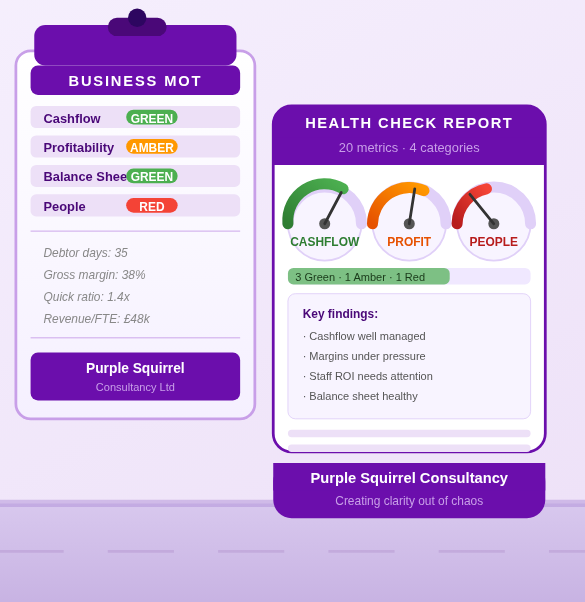
A financial health check - or Business MOT as I like to call it - is a structured review of the key metrics that tell you how your business is really performing. Not just whether you made a profit last month, but the deeper picture: how quickly your customers are paying you, whether your margins are holding up, whether your business could survive a sudden shock, and whether your team is generating the returns you need.
Done properly, it looks at four key areas:
- Cashflow - because profit and cash are not the same thing, and more businesses fail through poor cashflow than through lack of profit.
- Balance sheet - because understanding what you own, what you owe, and whether you could meet your obligations at short notice is fundamental to running a resilient business.
- Profit and loss - because knowing your margins, your cost base, and whether your sales are growing is the foundation of every good business decision.
- People - because your team is your biggest investment, and understanding the return you're getting on that investment matters more than most owners realise.
Why every six months?
Annual accounts are useful, but by the time they land on your desk, you could be looking at information that is 12, 15 or even 18 months old. A lot can change in that time - markets shift, costs rise, customers take longer to pay. If you only check in once a year, you can find yourself reacting to problems that have been quietly building for months.
A six-monthly review changes that completely. It gives you a current picture twice a year, which means you catch issues early, when they are still manageable, rather than when they have become a crisis. And it gives you something even more valuable: the ability to compare.
Is your gross margin improving or eroding? Are your debtor days getting better or worse? Is your working capital position stronger than it was six months ago? These are the questions that separate businesses that are merely surviving from businesses that are genuinely growing.

But I have an accountant - isn't that their job?
Your accountant is brilliant at what they do. But their job is primarily compliance: making sure your tax returns are filed, your accounts are accurate, and you are staying on the right side of HMRC. Most accountants are not in your business regularly enough to spot the kind of operational trends that a six-monthly health check reveals.
More importantly, even when your accountant does share financial information with you, do you always come away feeling clear about what it means? If you have ever sat in a meeting nodding along while quietly wondering what half of it actually means for your business, you are not alone. That gap between having the numbers and truly understanding them is exactly where a lot of small business owners find themselves.
A Business MOT bridges that gap. It takes your own figures and translates them into plain English, with a clear Red, Amber or Green rating on each metric, and straightforward commentary explaining what each result means and what you should consider doing about it.
What could you find out?
The results often surprise people. I have worked with business owners who thought their business was performing well, only to discover that their debtor days had crept up to 70 or 80 days, meaning they were effectively lending their customers two to three months of free credit without realising it. Others have found that while their top line looked healthy, their gross margin had quietly been eroding for months, driven by rising supplier costs they had not yet passed on to customers.
On the flip side, a health check can also be genuinely reassuring. Sometimes you discover that your business is in a much stronger position than you thought, and that confidence, grounded in real data rather than gut feel, is an incredibly powerful thing.
The businesses that grow are the ones that know their numbers
I have spent over 30 years working in corporate finance, and one thing I have seen time and again is this: the businesses that grow consistently are not always the ones with the best product or the biggest team. They are the ones where the owner takes the time to understand their financial position, review it regularly, and make decisions based on evidence rather than instinct.
You do not need to become a financial expert. You do not need to love spreadsheets. You just need to set aside a little time, twice a year, to look under the bonnet of your business and make sure everything is running as it should be.
That is exactly what a Business MOT helps you do.